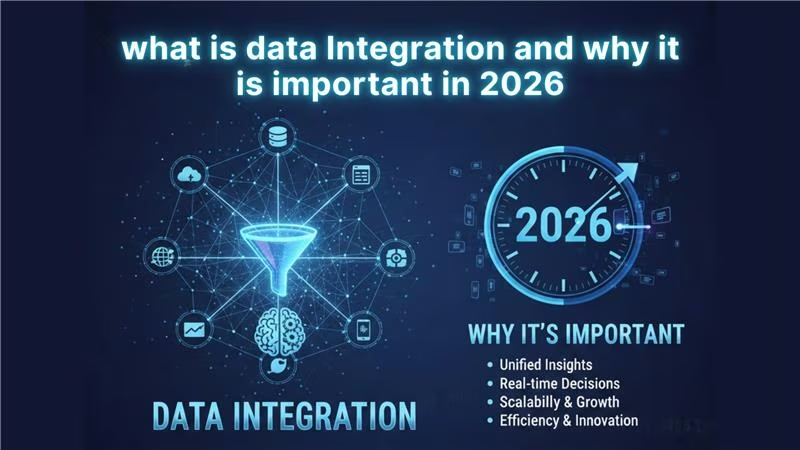
What is Data Integration and why it is Important in 2026
December 3, 2025TL;DR
Data integration is the practice of bringing data from many disconnected systems into a single, consistent, and reliable view. In 2026, it is no longer just a technical task but a core business requirement.
As organizations rely more on AI, automation, SaaS applications, and real-time decision-making, integrated data ensures accuracy, speed, and trust. It enables AI models to work correctly, supports real-time dashboards, simplifies compliance, improves customer and employee experiences, and reduces operational costs.
Key approaches include APIs, ETL/ELT pipelines, real-time streaming, iPaaS platforms, and AI-driven data extraction. Together, they connect systems, standardize data, and deliver a single source of truth.
In short, companies that treat data integration as foundational infrastructure gain faster insights, stronger governance, and a clear competitive advantage—while those that don’t risk slower decisions, unreliable AI, and fragmented operations.
Introduction
Data integration is the process of combining fragmented data from multiple sources into a single, usable view. It enables accurate analytics, automation, and decision-making.
In 2026, businesses generate and consume more data than ever before-from SaaS applications, IoT devices, cloud systems, AI models, customer platforms, and enterprise tools. Data Integration is the discipline that brings all these disconnected data sources together into a unified, usable, and trustworthy form. It combines processes, technologies, and architectures to transform fragmented data into insights that power automation, analytics, and decision-making.
Data Integration involves connecting multiple systems, standardizing data formats, cleansing inconsistencies, and delivering a single source of truth across the enterprise. This can include API-based integrations, ETL/ELT pipelines, real-time streaming, iPaaS platforms, AI-driven extraction, and cloud data warehousing.
Why Data Integration Is Critical in 2026
As organizations adopt AI, automation, and cloud technologies at scale, data integration becomes the backbone for business competitiveness. Here are the top reasons:
AI & Automation Depend on Unified Data
Without integrated data, AI systems operate on partial or outdated information, leading to inaccurate predictions and automation errors. Integrated data pipelines ensure AI models receive consistent inputs across training, inference, and monitoring stages.
AI models, copilots, and automation agents require clean, connected, and high-quality data. Without integration, AI output becomes inaccurate and unreliable. Explore eZintegration
Explosive Growth of SaaS & Multi-Cloud
As SaaS adoption accelerates, data becomes distributed across vendors with different schemas and update cycles. Integration platforms act as a control layer, synchronizing data while reducing vendor lock-in and integration complexity.
Modern companies use 150+ SaaS apps on average. Integration ensures seamless data flow across CRM, ERP, HR, finance, supply chain, and marketing systems.
Real-Time Decisions Are Now Mandatory
Real-time integration supports use cases such as fraud detection, dynamic pricing, inventory optimization, and live operational dashboards. These capabilities are increasingly expected rather than optional.
In 2026, leaders demand dashboards updated instantly-not weekly. Integrated streaming pipelines empower real-time analytics, forecasting, and alerts.
Compliance & Governance Are Stricter
Integrated data architectures simplify audit readiness by providing centralized visibility into data sources, transformations, and access controls. This reduces regulatory risk and improves trust in enterprise reporting.
With evolving privacy laws (GDPR updates, U.S. state regulations, AI governance policies), integration ensures accurate tracking, lineage, and controlled data access. For expert guidance, see Google Cloud Data Integration Overview
Better Customer & Employee Experience
When customer and employee data is unified, organizations can eliminate repeated data entry, reduce response times, and ensure consistent interactions across channels and departments.
Connected data enables:
Personalized customer journeys
Faster support resolution
Streamlined onboarding
Unified product experiences
Cost Efficiency & Operational Optimization
Over time, integration reduces IT overhead by minimizing custom point-to-point connections and lowering maintenance costs associated with fragmented systems.
Integrated data reduces:
Manual reconciliations
Duplicate work
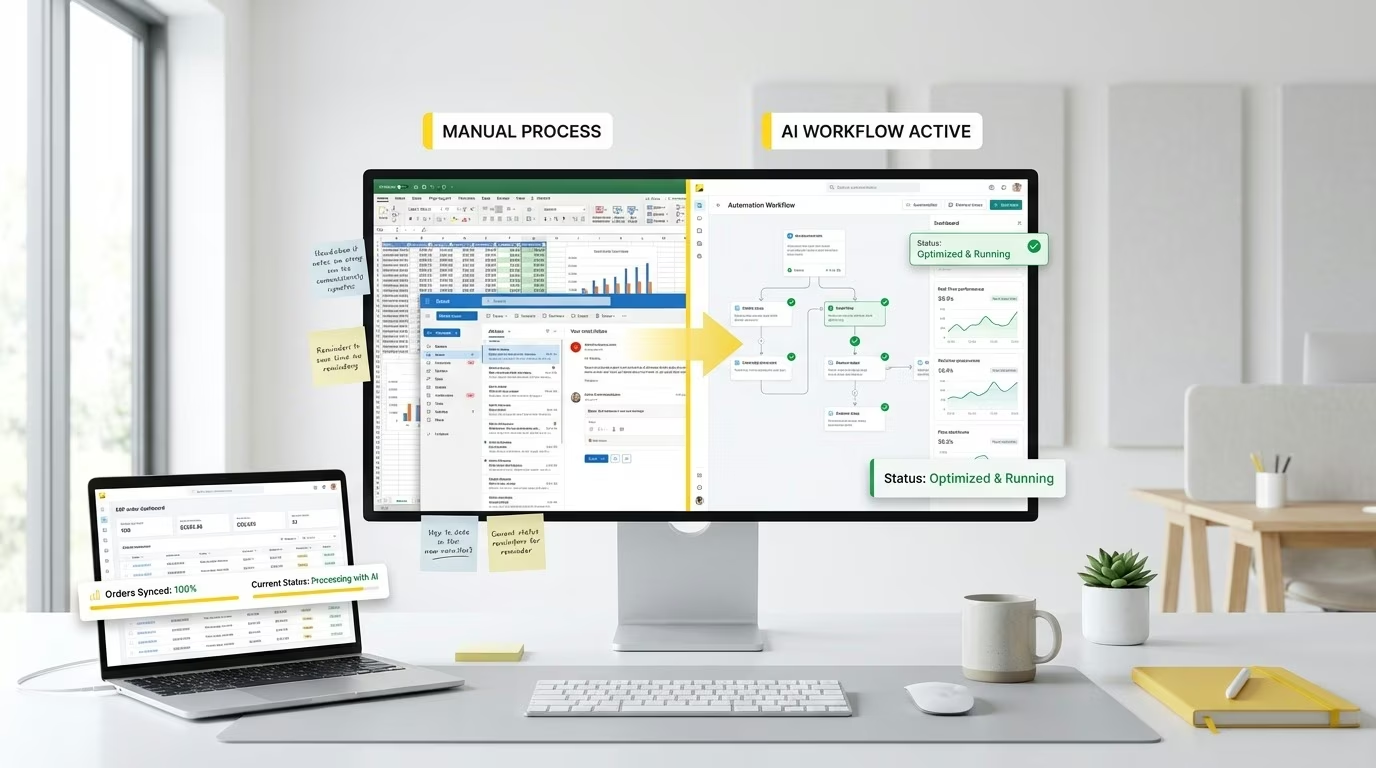
Spreadsheet-driven inefficiencies
Data silos that slow down teams
Competitive Advantage Through Insights
Integrated datasets enable advanced analytics such as predictive forecasting and scenario modeling, allowing organizations to anticipate market shifts rather than react to them.
Businesses in 2026 that can combine operational, customer, financial, and supply chain data outperform competitors by acting faster and predicting trends earlier.
Core data integration approaches explained
API-based integration: Enables real-time or near-real-time data exchange between applications.
ETL/ELT pipelines: Extract, transform, and load data for analytics and reporting, commonly used in data warehouses.
Real-time streaming: Continuously processes data from events such as transactions or IoT signals.
iPaaS platforms: Centralize and manage large numbers of integrations across SaaS and enterprise systems.
AI-driven extraction: Uses machine learning to process unstructured data such as documents, emails, and logs.
How data integration works in practice:
Connect: Data is pulled from SaaS, cloud, IoT, and enterprise systems via APIs or pipelines.
Standardize: Formats and schemas are aligned into a consistent structure.
Deliver: Clean data is made available for analytics, AI, and operations.
What problems does data integration solve?
Data integration addresses the challenge of fragmented information spread across disconnected systems. Without integration, organizations struggle with inconsistent reporting, delayed insights, and limited visibility across operations.
Common business problems solved include:
Conflicting reports from different departments
Manual data reconciliation and spreadsheet dependency
Limited AI accuracy due to incomplete datasets
Delays in decision-making caused by batch-based reporting
Common data integration use cases in 2026
Data integration supports a wide range of enterprise use cases, including:
AI and machine learning pipelines: Feeding models with consistent, governed data
Enterprise analytics: Combining operational and financial data for leadership dashboards
Customer 360 views: Unifying customer interactions across sales, marketing, and support
Supply chain visibility: Connecting logistics, inventory, and demand planning systems
Regulatory reporting: Ensuring accurate, auditable data for compliance submissions
Conclusion
Data integration in 2026 is no longer optional-it is a strategic necessity for AI growth, automation maturity, operational efficiency, and business continuity. Companies that invest in robust integration frameworks unlock faster decision-making, stronger compliance, and scalable innovation. Those who don’t risk falling behind in a rapidly accelerating, data-driven world.
Looking ahead, organizations that treat data integration as core infrastructure, rather than a one-time IT project, will be better positioned to scale AI initiatives, adapt to regulatory change, and innovate faster in uncertain markets.
FAQ
Data integration is the process of combining data from multiple sources, systems, or applications into a unified view, enabling seamless access and analysis.
In 2026, organizations rely on real-time insights, AI-driven analytics, and multi-cloud ecosystems, making integrated data essential for accurate decision-making and operational efficiency.
Benefits include improved data accuracy, enhanced reporting, streamlined workflows, reduced manual effort, and better business intelligence for strategic decisions.
Systems such as ERPs, CRMs, eCommerce platforms, databases, cloud applications, and analytics tools commonly require integration for a complete business view.
Integrated data ensures AI models and automated workflows have consistent, high-quality inputs, enabling accurate predictions, intelligent processing, and faster operations.
Trends include AI-driven ETL, real-time data streaming, low-code/no-code integration platforms, multi-cloud and hybrid integration, and enhanced data governance.1. What is data integration?
2. Why is data integration important in 2026?
3. What are the key benefits of data integration?
4. Which systems typically require integration?
5. How does data integration support AI and automation?
6. What trends are shaping data integration in 2026?